

About
Renewable Energy
My interest and experience in renewable energy
My interest in renewable energy isn't just theoretical — it's something we've been living step by step.

April 2020
We installed a photovoltaic (PV) system and started producing our own electricity.

December 2020
We switched to an electric car, combining clean mobility with solar power from our own roof.

November 2023
We replaced our heating system with a heat pump. With that change, we fully moved away from fossil fuels.
- of solar power from our roof, 2021 to 2025
- 44,435 kWh
- of the electricity the house used in these years came from the roof and the batteries
- 57%
- of gas since 2024 — in 2021 it was 1,239 m³
- 0 m³
- energy bought in 2025 than in 2021: grid electricity and gas
- 73% less
Year by year
Heat Pump Performance
3.6
COP (Coefficient of Performance)
~2,400
kWh for heating (2024)
~2,500
kWh for heating (2025)
What is installed
- Solar modules
- 9.87 kWp from 30 modules by Q-Cells. On the south-east roof 24 × 330 Wp = 7.92 kWp, running since 17 April 2020; on the north-west roof 6 × 325 Wp = 1.95 kWp, added in April 2021.
- Inverters
- E3DC S10 MINI (4.6 kW) and SMA Sunny Tripower 4.0.
- Batteries
- E3DC S10 MINI with 6.5 kWh (since 2020) and Marstek with 5.12 kWh (since May 2025).
- Heat pump
- Bosch Compress 6800i AW, air to water, refrigerant R290, running since November 2023. It replaced the gas heating.
- Electric car
- Tesla Model 3, since December 2020. Charging it at home takes about 1,700 to 2,200 kWh a year.
All figures
| Figure | 2021 | 2022 | 2023 | 2024 | 2025 |
|---|---|---|---|---|---|
| Solar power produced (kWh) | 8,636 | 9,928 | 8,884 | 7,960 | 9,027 |
| of it fed into the grid (kWh) | 3,904 | 4,931 | 3,881 | 3,118 | 3,329 |
| of it used ourselves (kWh) | 4,732 | 4,997 | 5,003 | 4,842 | 5,698 |
| Charged into the batteries (kWh) | 1,510 | 1,579 | 1,457 | 1,490 | 1,870 |
| Used by the house (kWh) | 6,807 | 6,571 | 7,864 | 8,962 | 9,716 |
| of it from the grid (kWh) | 2,588 | 2,100 | 3,301 | 4,554 | 4,455 |
| Gas (m³) | 1,239 | 772 | 443 | 0 | 0 |
| Gas (kWh, rounded) | 13,700 | 8,500 | 4,900 | 0 | 0 |
| Self-sufficiency | 62% | 68% | 58% | 49% | 54% |
| Self-consumption | 55% | 50% | 56% | 61% | 63% |
| Yield (kWh per kWp) | – | 1,006 | 900 | 806 | 915 |
- The house is a single-family home in Wesel, North Rhine-Westphalia. All figures are for calendar years: electricity from the yearly statistics of the home power system, gas from the readings of the meter.
- “Used by the house” is all the electricity the house used: solar power used directly, power from the batteries and power from the grid. Charging the car is in it and, since November 2023, the heat pump.
- “Used ourselves” is what was produced minus what went into the grid. The losses of the batteries and the needs of the system itself are in it, about 430 to 530 kWh a year.
- Self-sufficiency is the share of the house’s electricity that did not come from the grid. Self-consumption is the share of the solar power that we used ourselves.
- The yield per kWp is the production divided by 9.87 kWp. It starts in 2022: the modules on the north-west roof were added in April 2021.
- “Charged into the batteries” includes, in 2025, about 450 kWh that went into the second battery.
- Gas in kWh is the cubic metres times about 11.04, rounded. The gas year 2021 runs from 24 December 2020; that of 2023 ends with the change to the heat pump in November. The house uses no heating oil.
Today, our electricity, mobility, and heating are all based on renewable energy. It wasn't a single big leap, but a series of conscious decisions — and together, they made a fossil-free lifestyle possible.
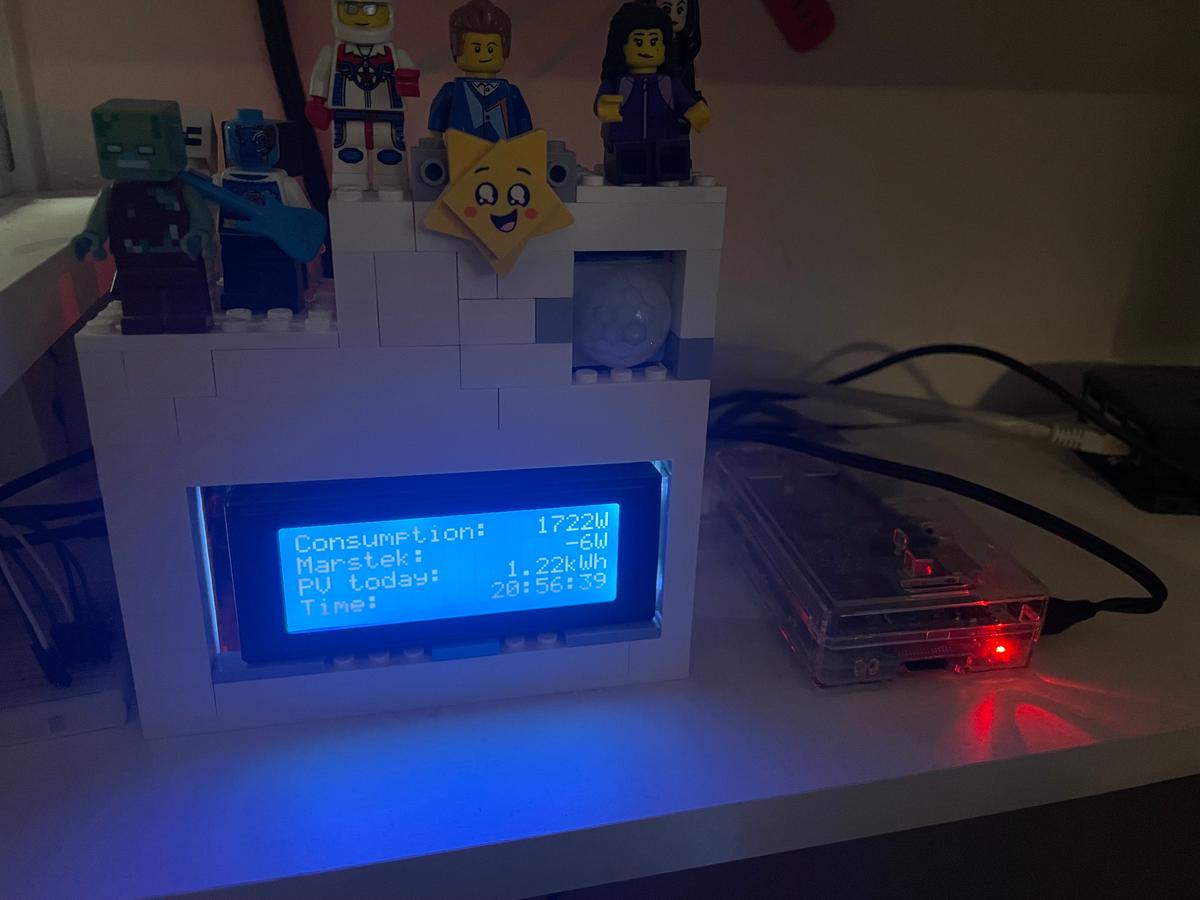
A display to show our current energy consumption
From the blog
- Unser Haus sagt uns, wann die Waschmaschine laufen soll Solaranlage, Batterien, Wärmepumpe und E-Auto – und ein kleines Programm, das alles zusammenführt. Ein Tag mit einem Haus, das Bescheid sagt, statt uns etwas vorzuschreiben.
- Was verbraucht mehr Fläche: Schottergärten oder Windräder?! Eine kleine Fermi-Rechnung über Vorgärten, Windkraft und die Frage, wie wir eigentlich mit Fläche umgehen.
- Klimaschutz und Wirtschaft - einfach für alle Zusammenhang zwischen Klimaschutz und Wirtschaftspolitik - einfach erklärt.
- Warum Klimaschutz auch Wirtschaftspolitik ist Ein datenbasierter Blick darauf, wie erneuerbare Energien regionale Wertschöpfung erzeugen und fossile Importe die deutsche Volkswirtschaft belasten.